


Make Your Own Apple Cider Vinegar Acne Remedy
Posted by Farah Afridi on
pple Cider Vinegar for Acne: The Internet Loves It. Your Skin Won't.
Short answer: There is no clinical evidence that apple cider vinegar clears acne, and there are published case reports of chemical burns from using it on skin. ACV is roughly a thousand times more acidic than your skin's surface; "balancing pH" is not what it does. Its antibacterial activity is real in a lab dish and irrelevant at concentrations your face can tolerate. Drinking it has modest evidence for blood sugar and none for acne, and it erodes tooth enamel. If you want an acid for acne, use one designed for skin.
Apple cider vinegar has been recommended for acne on approximately every wellness blog ever written, including, for many years, this one. So let's be the page that tells you the truth.
We went looking for the evidence. It isn't there. What is there is a growing pile of "I tried the ACV toner and now my face is peeling" stories and a few case reports in dermatology journals about burns. Here's what ACV actually does, why it feels like it's working when it isn't, and the safer ways to get what people are hoping ACV will give them.
Does apple cider vinegar help acne?
Not according to any published clinical trial, because there aren't any. Every claim you'll read for ACV on acne rests on three things:
- Acetic acid kills bacteria in a test tube. True. So does bleach. The concentration needed to meaningfully reduce acne bacteria on living skin is one that also damages living skin.
- It contains malic and citric acids, which are exfoliants. True, in trace amounts. A proper glycolic or salicylic product delivers those acids at a known strength and a skin-safe pH. ACV delivers an unknown strength at a pH that isn't.
- People say it worked. Some of that is the drying effect: ACV strips oil and shrinks a pimple the way any harsh astringent does, then the skin overproduces oil in response. Some of it is coincidence: acne fluctuates, and any remedy started during a flare will "work" as the flare resolves.
Why ACV can damage your skin
Your skin's surface sits at a mildly acidic pH of roughly 4.7 to 5.5. Apple cider vinegar sits around pH 2 to 3. Because the pH scale is logarithmic, that makes ACV somewhere between a hundred and a thousand times more acidic than your face. It isn't "restoring your pH"; it's overwhelming it.
Documented consequences of putting ACV on skin:
- Chemical burns. Case reports in dermatology literature describe burns from ACV applied to skin, including in a teenager following an online "remedy." Undiluted is worst, but 50/50, the dilution most blogs suggest (and this one used to), is still far too strong for facial skin.
- Barrier damage. Stripping the acid mantle leaves skin dehydrated, reactive and, in oily skin, oilier as it compensates. That's the opposite of what an acne routine should do.
- Post-inflammatory marks. Irritated, burnt skin on an acne-prone face heals with dark marks, especially on medium and deeper skin tones.
- Reactions with actives. Layered with retinoids, benzoyl peroxide or exfoliating acids, it multiplies irritation.
| Apple cider vinegar | Salicylic acid product | Glycolic acid product | |
|---|---|---|---|
| pH | ~2–3, unknown strength | Formulated ~3–4, known strength | Formulated ~3.5–4, known strength |
| Reaches inside the pore | No | Yes (oil-soluble) | No |
| Evidence for acne | None | Strong | Moderate |
| Burn risk | Real, documented | Low when used as directed | Low when used as directed |
| Cost | Cheap | Cheap to moderate | Cheap to moderate |
What about drinking apple cider vinegar for acne?
The honest version:
- Blood sugar. A few small studies suggest a tablespoon or two of vinegar with a meal blunts the post-meal glucose rise slightly. Since high-glycaemic eating is linked to acne, that's a plausible indirect benefit. It's also a modest effect you'd get from eating protein and fibre with the meal.
- Digestion and "gut bacteria." The "mother" in unfiltered ACV contains some bacteria and enzymes, but there's no evidence they survive stomach acid in meaningful numbers or change your gut microbiome. Proper prebiotics and probiotics do; ACV doesn't.
- Potassium. A tablespoon of ACV has about as much potassium as a bite of banana. "Packed with potassium" is marketing.
- Toxins. Not a thing. Your liver and kidneys handle waste.
- Downsides. Undiluted or frequent ACV erodes tooth enamel and can irritate the throat and oesophagus. It can interact with diuretics, insulin and some heart medications. There's at least one published case of dangerously low potassium from heavy long-term intake.
Net: a diluted splash with a meal is harmless for most people and might help your blood sugar a touch. As an acne treatment, it's a no.
If you're going to use it anyway
We'd rather you didn't. But if you're determined:
- Dilute at least 1 part ACV to 4 parts water. Not 50/50. More water if your skin is sensitive.
- Patch test on your inner arm for 24 hours first.
- Apply with a cotton pad, rinse off after a few minutes. Never leave it on overnight, never under occlusion, never on broken skin.
- Not near the eyes, not on a burn, not on a spot you've picked.
- Stop at the first sign of stinging that doesn't fade, redness that lasts, or peeling. That's damage, not "purging."
- Don't combine with retinoids, benzoyl peroxide or other acids in the same routine.
What to use instead
The things people want from ACV, delivered safely:
- An acid that clears pores: salicylic acid, 0.5–2%, in a cleanser or leave-on. It's oil-soluble, so it gets into the pore, which ACV can't.
- Antibacterial action: benzoyl peroxide at 2.5–5%, or a gentle cleanser with green tea. Our Acne Control Cleansing Mousse clears oil without stripping and calms with aloe and green tea; it's what a "toner step" should feel like on acne-prone skin.
- Blood sugar and gut support: protein and fibre with meals, less sugar, and real prebiotics and probiotics. Our Clear Skin Superfood Booster is built for that side of the equation.
- Oil control from within: the thing ACV can't touch at all. Our Extra Strength Acne Control Vitamins use high-dose Vitamin B5 to support healthy oil balance from the inside, which is where most acne starts
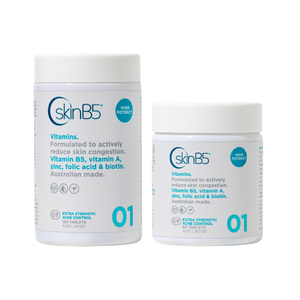
Extra Strength Acne Control Vitamins - choose from 2 pack sizes
Add To Cart -
Skin Rescue Vitamins - One a Day
Add To Cart -FAQs
Does apple cider vinegar get rid of acne?
No clinical evidence supports it. Its antibacterial effect is only shown in lab conditions, and on skin its acidity causes irritation and, in documented cases, chemical burns.
Can I use apple cider vinegar as a toner?
It's not recommended by dermatologists. If you do, dilute at least 1:4 with water, patch test, rinse off after a few minutes, and stop at any lasting stinging or peeling. A formulated salicylic acid product is safer and more effective.
Does drinking apple cider vinegar help your skin?
Not directly. It may modestly reduce post-meal blood sugar, which is loosely linked to acne, but there's no evidence it clears skin. It can erode tooth enamel and interact with some medications.
Can apple cider vinegar burn your face?
Yes. Chemical burns from ACV on skin are documented in medical literature, particularly from undiluted or strong dilutions left on the skin.
Does apple cider vinegar balance skin pH?
No. Skin sits around pH 4.7–5.5; ACV is around pH 2–3, which is hundreds of times more acidic. Applying it overwhelms the skin's natural acid mantle rather than restoring it.
What's a safer natural acid for acne?
Salicylic acid (from willow bark originally) and glycolic acid in formulated products at skin-safe pH. Both have clinical evidence for acne and known, controlled strengths.
Skip the salad dressing. Treat the cause. The SkinB5 Starter Kit pairs Vitamin B5 supplements that support oil balance from within with a gentle cleanse and moisturise that won't strip your skin.
Related reading: DIY Skin Care Solutions: Proven Skin Care Solutions · DIY Natural Acne Remedies · Natural Remedies to Relieve Inflammation in Acne-Prone Skin
Skin Health & Wellness Articles
RSS
Does Drinking Water Help Acne?
Does Drinking Water Help Acne? Not the Way You've Been Told. Short answer: No, drinking water doesn't clear acne. There's no good evidence that water...

Are Pimple Patches Actually Effective?
Pimple patches have quickly become a staple in modern skincare routines, earning widespread attention for their ability to target blemishes with precision. These tiny, sticker-like...


