


Why Jojoba oil is amazing for Acne prone skin?
Posted by Farah Afridi on
Jojoba Oil for Acne: The "Oil" That's Actually a Wax, and Why That's the Whole Point
Short answer: Jojoba oil is good for acne-prone skin because it isn't really an oil. It's a liquid wax ester that closely resembles the wax esters in human sebum, so skin absorbs it without treating it as a foreign grease. It's non-comedogenic, mildly anti-inflammatory, stable, and an excellent lightweight moisturiser and oil cleanser for skin that's oily but dehydrated. What it doesn't do: kill acne bacteria, "trick" your skin into producing less oil, or heal scars. Use it as a moisturiser or cleanser, not as a treatment.
Putting oil on oily skin sounds like the worst idea in skincare. For most plant oils, it is. Coconut oil clogs pores. Olive oil sits on top and does nothing useful. And then there's jojoba, which acne-prone people have sworn by for decades, and the reason it works is a chemistry quirk worth understanding.
What is jojoba oil?
Jojoba (pronounced ho-HO-ba) is pressed from the seeds of Simmondsia chinensis, a desert shrub native to the south-western US and Mexico. Despite the name, it's not a triglyceride oil like olive or coconut. It's a liquid wax ester, a long-chain fatty acid bonded to a long-chain fatty alcohol.
That matters because human sebum is roughly a quarter wax esters. Jojoba is the closest thing in the plant world to the stuff your own skin makes. Your skin recognises it, absorbs it readily, and doesn't respond to it the way it responds to heavy foreign fats.
Is jojoba oil good for acne? What it actually does
| Claim | Evidence | Verdict |
|---|---|---|
| Non-comedogenic | Consistently rated low on comedogenicity scales; wax esters don't oxidise into pore-clogging compounds the way many oils do | True. This is its main advantage |
| Lightweight moisturiser | Absorbs quickly, supports the barrier without a greasy film | True |
| Anti-inflammatory | Some studies show reduced redness and inflammation; a small uncontrolled trial of a clay-jojoba mask reported fewer lesions | Modestly true; evidence is limited |
| Supports wound healing | Lab studies show it supports skin cell repair | Plausible; human evidence thin |
| Stable, long shelf life | Wax esters resist oxidation far better than plant oils | True, and useful: rancid oils irritate skin |
| Kills acne bacteria | Weak antimicrobial activity in lab tests only | Overstated; don't rely on it |
| "Tricks skin into making less oil" | No evidence for this popular claim | Myth |
| Heals acne scars | No evidence; vitamin E content is modest and vitamin E isn't a proven scar treatment | Myth |
| Balances skin pH | Oils and waxes have no meaningful effect on skin pH | Myth |
So jojoba's real value isn't that it treats acne. It's that it lets acne-prone skin have what every skin needs, moisture and a healthy barrier, without paying the usual price. And that has a knock-on effect: dehydrated, barrier-damaged skin overproduces oil to compensate. Hydrate it properly and that rebound eases.
Why acne-prone skin needs moisture at all
The instinct with oily, breaking-out skin is to strip it: harsh cleansers, no moisturiser, drying spot treatments. It backfires. A stripped barrier loses water, becomes reactive, and the oil glands respond by producing more. You end up tight and shiny.
Jojoba is the answer to that trap. It gives the barrier what it needs in a form the skin accepts, without the clogging risk of richer creams or the film of heavier oils. It also buffers the irritation from actives: a thin layer after salicylic acid, benzoyl peroxide or a retinoid takes the sting out without cancelling the treatment.
How to use jojoba oil for acne-prone skin
1. As your moisturiser, or in it. Two or three drops pressed into damp skin after cleansing, or mixed into a light moisturiser. Our Acne Control Moisturiser is built on this idea: jojoba as the base, with aloe to calm and Vitamins B5 and E to support the barrier. One or two pumps covers the face; it absorbs without shine.
2. As an oil cleanser. This is the one place "dissolves sebum" is legitimate: like dissolves like, so massaging jojoba into dry skin loosens sunscreen, makeup and oxidised sebum that water-based cleansers leave behind. Follow with a gentle foaming cleanse (our Acne Control Cleansing Mousse) to lift it all off. Full method: How to Use a Cleansing Oil in Your Daily Routine.
3. As a buffer for actives. Apply your retinoid or acid, wait a few minutes, then a thin layer of jojoba or jojoba-based moisturiser on top.
4. Not as a spot treatment. It won't shrink a pimple. Use a proper spot treatment for that and jojoba for everything around it.
Patch test first. Reactions are uncommon but possible. And buy cold-pressed, unrefined, golden jojoba; clear, deodorised versions have been processed harder.
Jojoba vs other oils for acne
| Oil | Comedogenic risk | Verdict for acne-prone skin |
|---|---|---|
| Jojoba | Very low | Best all-rounder |
| Squalane | Very low | Excellent alternative; very light |
| Rosehip | Low | Good for post-acne marks; oxidises fast, keep refrigerated |
| Avocado | Low-moderate | Fine for dry, acne-prone skin (our guide) |
| Olive | Moderate | Skip on the face |
| Coconut | High | Avoid on acne-prone skin (why) |
The bit jojoba can't do
Jojoba takes care of the surface: barrier, hydration, calm. It has nothing to say about how much oil your glands produce in the first place, which is set by hormones and genetics and is where acne starts.
That's the inside job. Our Extra Strength Acne Control Vitamins use high-dose Vitamin B5 to support healthy oil balance from within. Jojoba on the outside, B5 on the inside: the surface stops fighting you, and the source stops overproducing. That's the whole SkinB5 Starter Kit, made in Australia under good manufacturing practice.
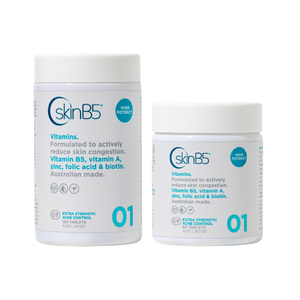
Extra Strength Acne Control Vitamins - choose from 2 pack sizes
Add To Cart -
SkinB5 Starter Kit (FREE Bonus Mask)
Add To Cart -FAQs
Is jojoba oil good for acne?
Yes, as a moisturiser and cleanser for acne-prone skin. Its wax esters resemble human sebum, so it hydrates and supports the barrier without clogging pores. It isn't an acne treatment on its own.
Does jojoba oil clog pores?
No. It's consistently rated very low on comedogenicity scales and, unlike most plant oils, doesn't oxidise into pore-clogging compounds.
Does jojoba oil reduce oil production?
There's no evidence it signals your glands to make less oil. It can reduce the rebound oiliness that comes from dehydrated, stripped skin by restoring the barrier.
Can I use jojoba oil with salicylic acid or retinoids?
Yes. It's a good buffer: apply the active first, then a thin layer of jojoba or a jojoba-based moisturiser to reduce irritation.
Does jojoba oil help acne scars?
Not meaningfully. It can keep healing skin hydrated and calm, which helps marks fade on their own, but it isn't a scar treatment.
Which is better for acne, jojoba or coconut oil?
Jojoba, by a wide margin. Coconut oil is highly comedogenic and a common cause of breakouts; jojoba is one of the least likely oils to clog pores.
Moisturise the oily skin. Then balance the oil. SkinB5 Acne Control Moisturiser on the surface, Extra Strength Acne Control Vitamins from within.
Related reading: Benefits of Cleansing Oil for Acne-Prone Skin · Aloe Vera for Acne · Avocado Oil: Natural Acne Remedy
Skin Health & Wellness Articles
RSS
Does Drinking Water Help Acne?
Does Drinking Water Help Acne? Not the Way You've Been Told. Short answer: No, drinking water doesn't clear acne. There's no good evidence that water...

Are Pimple Patches Actually Effective?
Pimple patches have quickly become a staple in modern skincare routines, earning widespread attention for their ability to target blemishes with precision. These tiny, sticker-like...


